Poles and bollards0 / 302 models
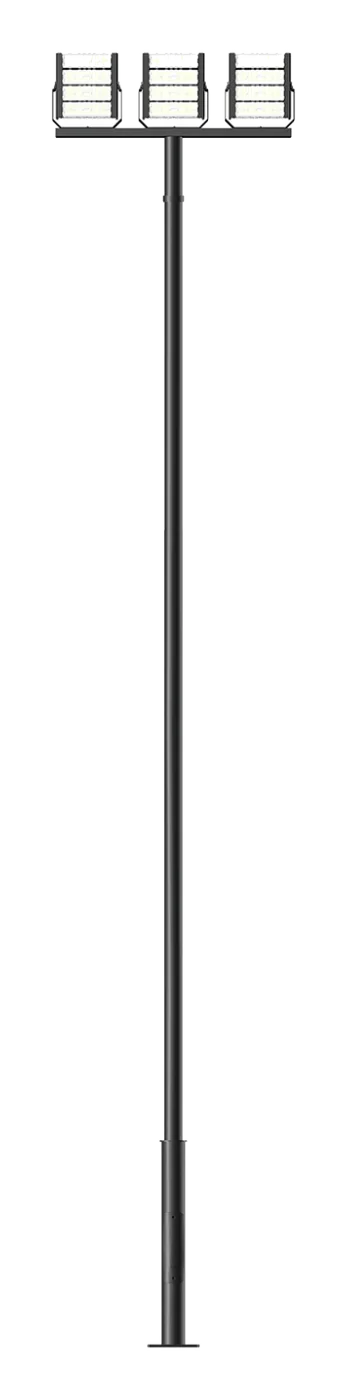
Area lighting poles are tall poles, usually 8 to 12 m in car parks and yards and up to 15 m on sports grounds, that carry several heads or floodlights to light a wide open space evenly from fewer positions. In a typical open car park, poles of 8 to 12 m spaced 25 to 35 m apart are a common starting point, with 4000 K light. The final layout comes from a calculation, because in a large open space uniformity matters more than brightness.
| Space | Mounting height | Typical spacing | Colour temperature |
|---|---|---|---|
| Open car parks | 8 – 12 m | 25 – 35 m | 4000 K |
| Industrial and logistics yards | 8 – 12 m | 25 – 35 m | 4000 – 6000 K |
| Sports grounds | 12 – 15 m | Set by layout | 4000 K |
| Junctions and wide forecourts | Set by layout | Set by layout | 4000 K |
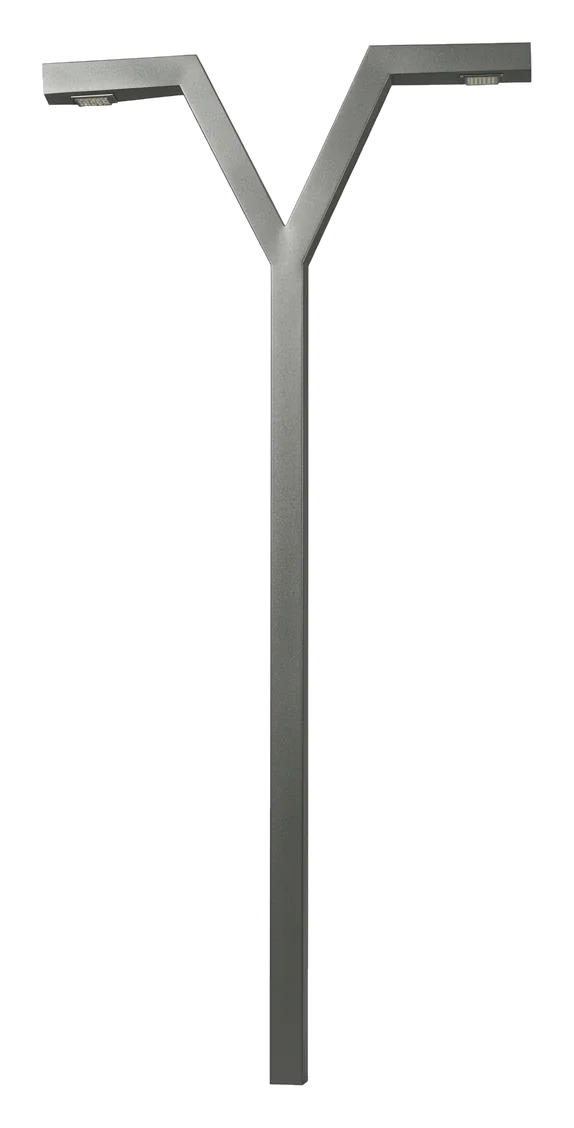
Area lighting poles from Luminex run from 6 to 15 m in GI or MS, with multi-head crossarms and ring-mounted floodlights, rated IP66 and IK10 and designed for wind load. For smaller car parks beside buildings, and along the roads that lead to them, square poles of 3 to 9 m with single, twin or angled heads keep the look consistent with the rest of the site.
Our article on street light pole height and spacing explains the spacing to height ratio and how uniformity is measured.
Most area lighting uses forward-throw or wide distributions. Type IV, a long forward throw with almost nothing behind the pole, suits perimeters and building frontages where the back of the pole faces a boundary. Type V, an even circle all round, suits poles in the middle of open space. Our lighting guide shows each type.
Tall poles carrying several heads catch a lot of wind, so the structure matters as much as the light. Shaft size, wall thickness, base plate and foundation are designed for the basic wind speed of the site under IS 875 (Part 3) and for the area of the heads and crossarm. Hot-dip galvanised steel suits tall poles, because it combines stiffness with protection inside and out.
Our guide to IP and IK ratings explains the numbers.
Car parks and yards are often busy for a few hours and nearly empty for the rest of the night.
Ask us anything else when you request a quote.
Open car parks and yards commonly use area lighting poles of 8 to 12 m, spaced 25 to 35 m apart, with 4000 K light. Smaller car parks beside buildings can use lower poles that match the site's street lighting, and a calculation confirms the layout.
It depends on the area, the shape of the car park, the light level wanted and the luminaires chosen. A spacing of 25 to 35 m for 8 to 12 m poles gives a first count, which a lighting calculation then refines for even light.
A crossarm carries several heads in a fixed row and suits even light over parking. A ring lets each floodlight be mounted and aimed separately around the pole, which suits sports grounds, yards and irregular spaces.
IP66 is the usual choice for floodlights on area poles, because they are exposed to driving rain and are sometimes washed down. Add IK08 to IK10 impact resistance where heads may be struck by stones or balls.
4000 K neutral white is the common choice for car parks and yards. It gives crisp light that helps drivers and suits CCTV. Keep 6000 K for industrial and security areas, away from homes and gardens.
Articles that go deeper into heights, spacing, materials and ratings.