Lighting basics6 min read
IP and IK ratings for outdoor lights: IP65, IP66 and IK10
IP ratings tell you how well an outdoor light keeps out dust and water; IK ratings, how well it survives knocks. What the numbers mean and which to specify where.
By the Luminex Electronics design team, Ahmedabad
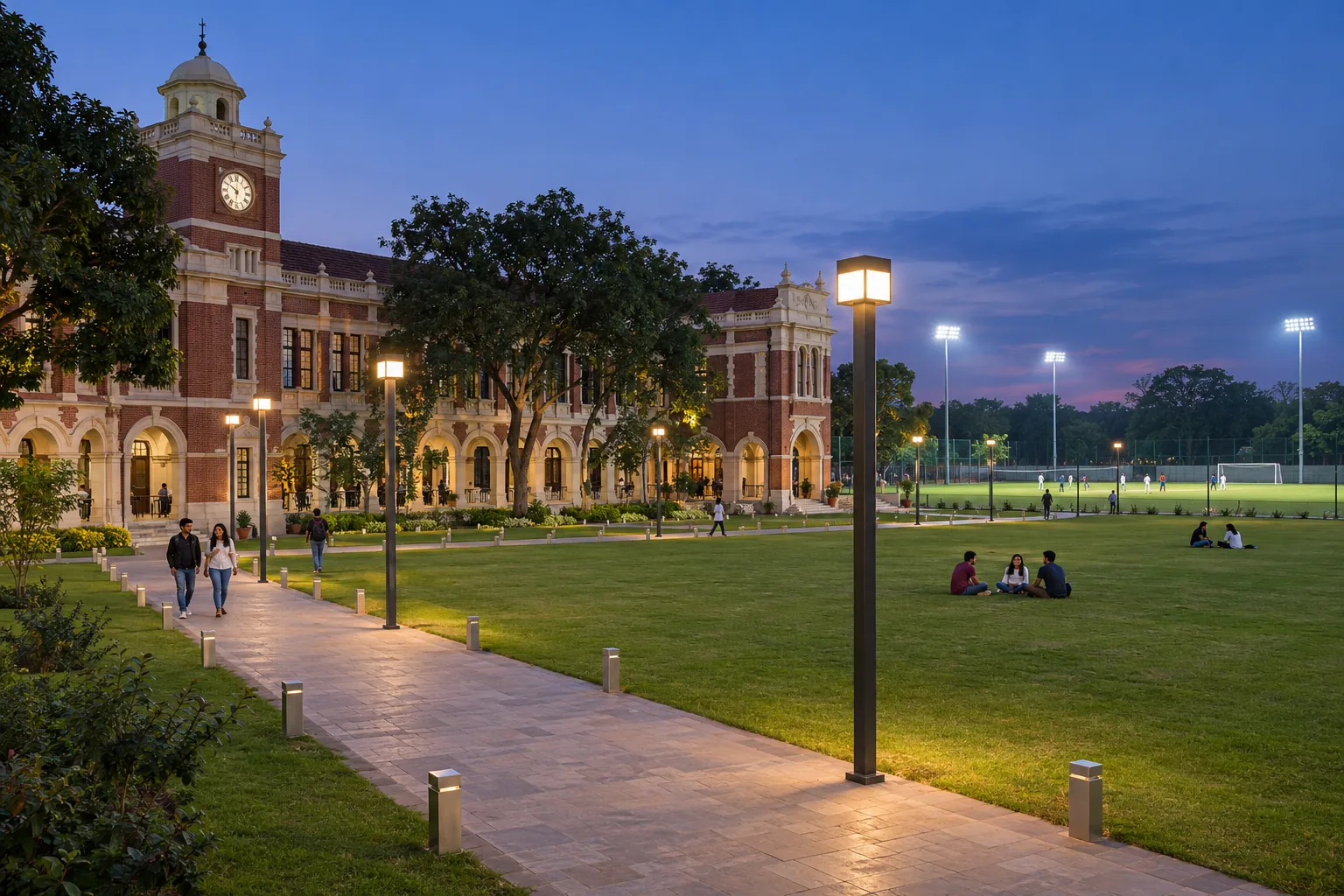
IP and IK ratings tell you how well an outdoor light keeps out dust and water, and how well it survives knocks. IP65 and IP66 mean a light is dust tight and protected against water jets, and IK10 means its enclosure has passed the highest impact test in the standard. For most outdoor poles and bollards, IP65 is the sensible minimum, IP66 suits exposed sites and areas that are hosed down, and IK08 to IK10 suits anywhere the fitting can be knocked or reached by vandals.
How an IP rating is written
An IP (ingress protection) rating comes from IEC 60529 and has two digits. The first digit covers solid objects and dust, from 0 to 6. The second covers water, from 0 to 8. IP65 therefore means dust tight (6) and protected against water jets (5). An X in place of a digit, as in IPX5, means that part was not tested or rated.
The first digit: solids and dust
| Digit | Protection against |
|---|---|
| 0 | No protection |
| 1 | Objects over 50 mm, such as a hand |
| 2 | Objects over 12.5 mm, such as fingers |
| 3 | Objects over 2.5 mm, such as tools |
| 4 | Objects over 1 mm, such as wires |
| 5 | Dust protected: some dust may enter, not enough to cause harm |
| 6 | Dust tight: no dust enters |
Outdoor luminaires should be 6. Dust that settles on the LED, optic or driver cuts light output and traps heat, and in India's dry months it gets everywhere.
The second digit: water
| Digit | Protection against |
|---|---|
| 0 | No protection |
| 1 | Dripping water |
| 2 | Dripping water with the fitting tilted up to 15° |
| 3 | Spraying water up to 60° from vertical |
| 4 | Splashing water from any direction |
| 5 | Water jets from any direction |
| 6 | Powerful water jets |
| 7 | Temporary immersion, up to 1 m |
| 8 | Continuous immersion beyond 1 m, under conditions agreed with the manufacturer |
IP65, IP66 and IP67 in practice
The difference between 5 and 6 is the force of the water. The IPX5 test sprays water from a 6.3 mm nozzle at 12.5 litres per minute; the IPX6 test uses a 12.5 mm nozzle at 100 litres per minute. Both come from every direction.
- IP65 suits most pole tops, post tops and bollards in gardens, societies and campuses, where rain and sprinklers are the main exposure.
- IP66 suits exposed and coastal sites, floodlights on area poles, and anything that will be washed down with a hose or pressure washer.
- IP67 and IP68 are for fittings that may sit in water: in-ground uplights, fittings in water features and lights in areas that flood.
One detail catches people out. A 7 or 8 does not automatically include 5 or 6, because immersion and jets are different tests. A fitting that has passed both is marked with both ratings, such as IP66/IP67.
IK ratings: impact resistance
The IK rating comes from IEC 62262 and measures how much impact energy an enclosure can take, in joules, from IK00 to IK10. The test drops or swings a weight onto the enclosure.
| IK rating | Impact energy | Roughly equivalent to |
|---|---|---|
| IK06 | 1 joule | 0.25 kg dropped from 400 mm |
| IK07 | 2 joules | 0.5 kg dropped from 400 mm |
| IK08 | 5 joules | 1.7 kg dropped from 300 mm |
| IK09 | 10 joules | 5 kg dropped from 200 mm |
| IK10 | 20 joules | 5 kg dropped from 400 mm |
The scale is not linear: IK10 is four times the energy of IK08. Glass and polycarbonate diffusers reach high IK ratings in different ways, so check the rating of the actual fitting rather than the material.
Which IP and IK ratings to specify where
These are commonly used starting points. A site with heavy use, coastal air or a history of vandalism may justify a step up.
| Location | IP rating | IK rating |
|---|---|---|
| Garden post tops and lanterns on private grounds | IP65 | IK08 |
| Society roads and campus paths | IP65 | IK08 |
| Bollards in public parks, schools and plazas | IP65 | IK10 |
| Light columns and low fittings within reach | IP65 | IK10 |
| Car parks, yards and sports floodlights | IP66 | IK08 – IK10 |
| Coastal promenades and exposed waterfronts | IP66 | IK08 – IK10 |
| In-ground uplights and fittings in water features | IP67 or IP68 | IK10 if they can be walked or driven over |
Height matters for IK. A luminaire at 8 m is hard to reach; a bollard or column light at hand height is not. Our guide to bollard lights covers where low fittings work best.
Reading a datasheet
An IP or IK number is only useful if you know what it covers.
- Which part is rated: the rating usually applies to the luminaire, not the pole, the door or the base junction box. Ask about those separately.
- Who tested it: ask whether the rating comes from a test report, and for which model and size.
- Installation: an IP65 fitting loses its rating if the cable gland is left loose, the wrong cable size is used or the gasket is pinched during fitting. Leave a drip loop in the cable so water runs off before it reaches the gland.
- Monsoon: wind-driven rain, standing water around bases and months of high humidity test every seal. Bring cables in from below where possible, keep junction boxes above flood level and check seals after the first monsoon.
- Ageing: gaskets harden with years of sun and heat. Good silicone gaskets and a design that keeps water off the seal hold their rating longer.
- Heat: a sealed fitting has to shed heat through its body, so a well-designed heat sink matters more as sealing improves.
Our lighting guide keeps the full IP and IK tables for quick reference.
Frequently asked questions
What is the difference between IP65 and IP66?
Both are dust tight; the difference is the force of the water. The IP65 water test uses jets from a 6.3 mm nozzle at 12.5 litres per minute, while IP66 uses powerful jets from a 12.5 mm nozzle at 100 litres per minute.
Is IP65 good enough for outdoor lights?
Yes, for most pole tops, post tops and bollards in gardens, societies and campuses, where rain and sprinklers are the main exposure. Choose IP66 for exposed and coastal sites, floodlights on area poles, and anything washed down with a hose or pressure washer.
What does IK10 mean on a light?
IK10 is the top of the IEC 62262 impact scale. The enclosure has withstood an impact of 20 joules, roughly a 5 kg weight dropped from 400 mm, which is four times the energy of the IK08 test.
Is IP67 better than IP66 for street lights?
Not necessarily. IP67 covers temporary immersion while IP66 covers powerful water jets, and a 7 does not automatically include a 6. For lights on poles, jets and rain are the real exposure, and a fitting that has passed both tests is marked IP66/IP67.
IP and IK ratings across the Luminex range
Specify IP65 as the minimum outdoors, IP66 for exposed sites and washdown, and IK08 to IK10 depending on how easily the fitting can be reached. Luminex column lights are rated IP65 and IK10, area lighting poles IP66 and IK10, and architectural bollards IP65 and IK10. Each range page lists its ratings. Tell us where the lights will go and request a quote.