Poles and bollards0 / 302 models
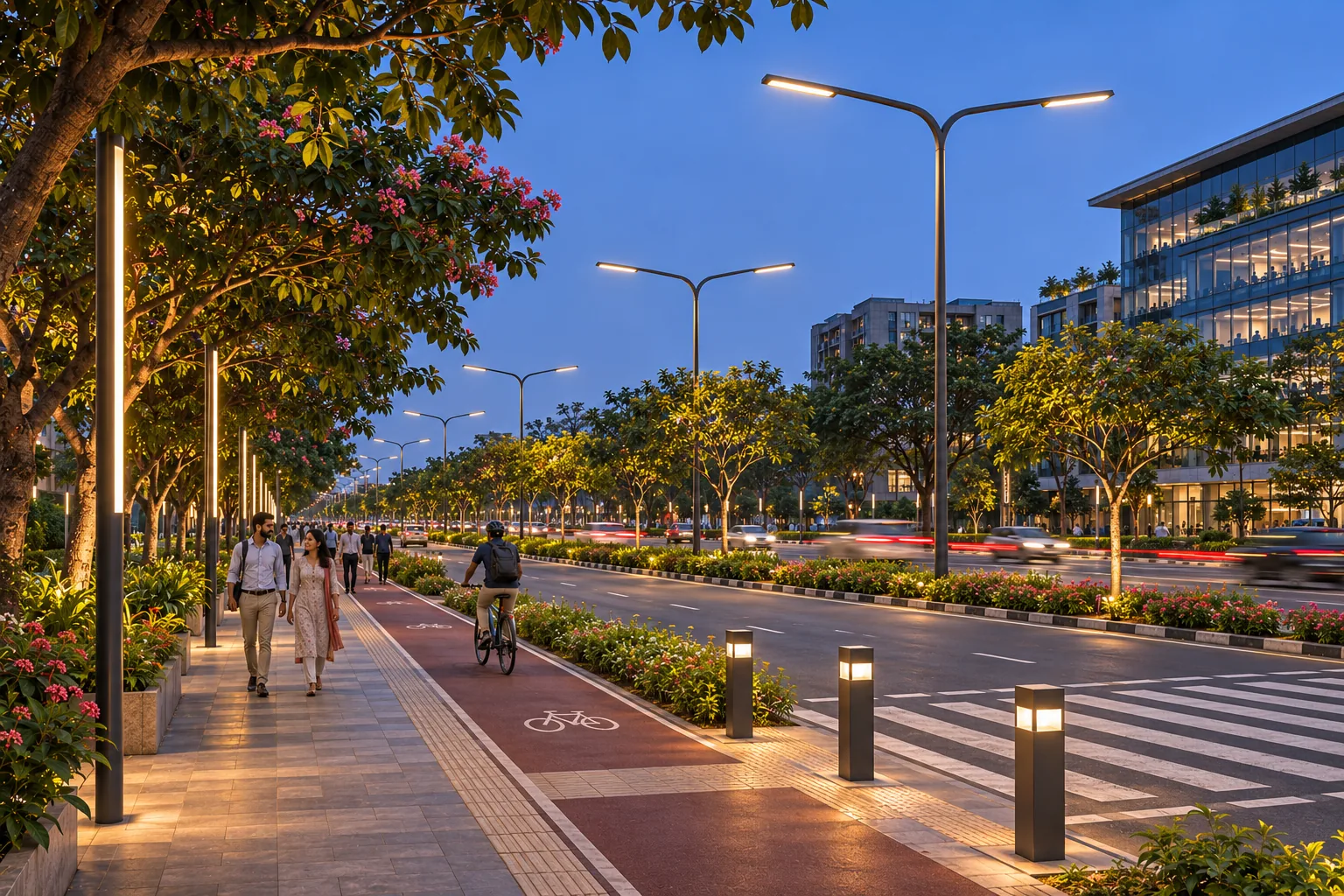
A decorative street light pole has to light the road to a measured level and still give the street a character of its own, through the shape of its shaft, arm and head. For society and internal roads, poles of 4 to 6 m set 15 to 25 m apart are a common starting point. Avenues and campus roads usually take 6 to 8 m poles at 20 to 30 m, and main roads 9 to 12 m arm-mounted poles at 30 to 40 m. The decorative detail is added to that, never in place of it.
A plain street pole is a tube with a bracket. A decorative one is designed as part of the street, in a handful of parts.
On a main road the pole is seen at speed, so a clean profile and a well-drawn arm matter most. On a society lane or shopping street, people pass at arm's length, so the base, the door and the finish are noticed too.
| Road | Mounting height | Typical spacing | Colour temperature | Ranges to look at |
|---|---|---|---|---|
| Society and internal roads | 4 – 6 m | 15 – 25 m | 3000 K | Round poles, square poles |
| Avenues and campus roads | 6 – 8 m | 20 – 30 m | 3000 – 4000 K | Square poles, round poles with arms |
| Main roads | 9 – 12 m | 30 – 40 m | 4000 K | Arm-mounted round poles, up to 10 m |
These are starting points for a first layout. On roads, spacing usually works out at three to four times the mounting height, and a lighting calculation with the luminaire's photometric file confirms the final figure. Our article on street light pole height and spacing explains the IS 1944 light levels and layout rules behind the table.
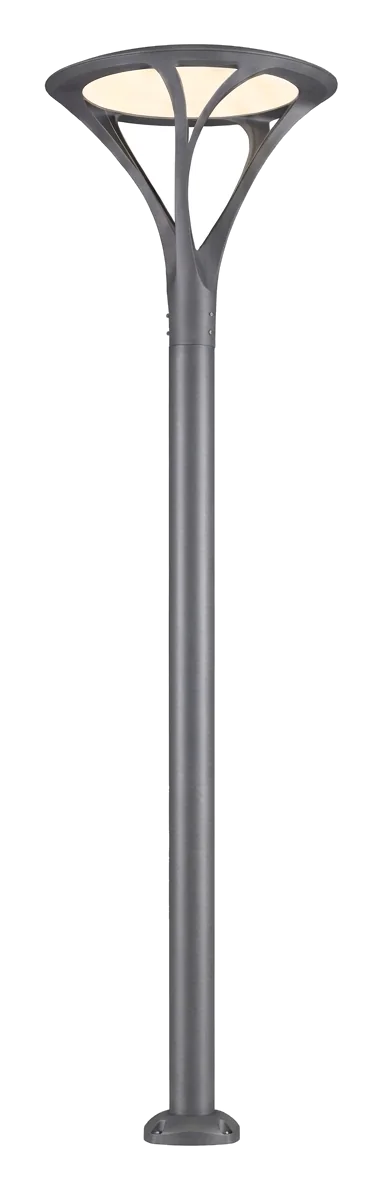
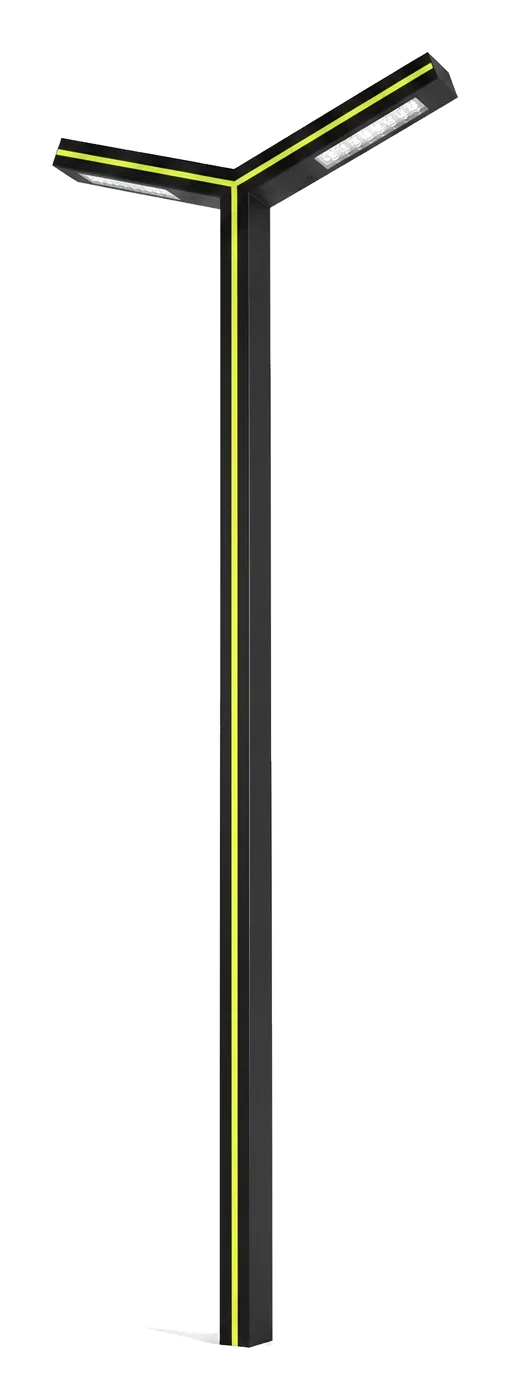
Round poles are the broadest family, from 3 to 10 m, with tapered or straight shafts. Square poles run from 3 to 9 m with concealed fixings and suit modern avenues. Profile poles, with LED light lines along the body, mark a boulevard footpath or waterfront rather than light a carriageway.
The width of the road compared with the mounting height decides the arrangement. A road no wider than the mounting height can be lit from one side. Wider roads use staggered poles, poles in opposite pairs, or twin-arm poles in a central median.
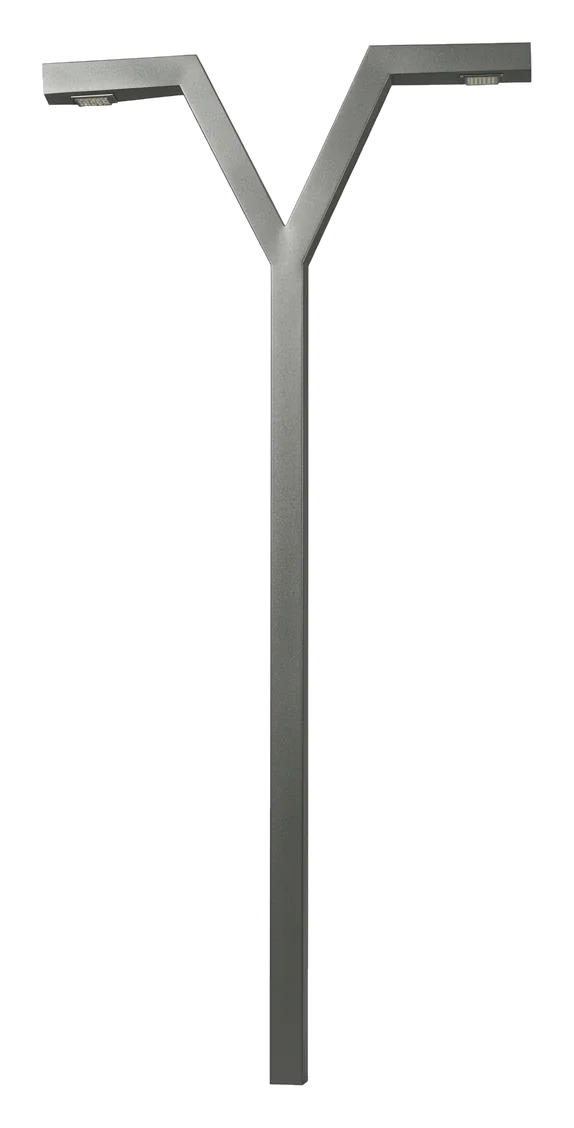
Keep the arm modest. The 1970 edition of IS 1944 advises that the overhang beyond the kerb should not generally exceed a quarter of the mounting height, or the footpath falls into shadow. Round poles come in single, twin and cluster versions with post top or arm-mounted heads, and square poles with single, twin and angled heads. Our page on single and double arm poles compares the options.
A handsome pole with the wrong optic still gives patchy light. Along a road, an asymmetric Type II or Type III distribution throws light along and across the carriageway from a pole at its edge. Post tops with a symmetric Type V distribution suit plazas and junctions. Our lighting guide shows each type.
Luminex pole luminaires use LED from 24 to 100 W in 3000 K, 4000 K or 6000 K. Choose 3000 K for residential and shopping streets, where people live and walk beside the light, and 4000 K for main roads. Ask for flat-glass, shielded optics wherever homes face the road, and consider dimming after midnight on quiet streets. IP65 is the sensible minimum for luminaires outdoors.
Hot-dip galvanised (GI) steel is the sensible default for street poles, because the zinc protects the shaft inside and out. Mild steel suits sheltered or budget work where repainting is planned, and aluminium suits coastal streets and lighter pieces. A powder coat over the galvanising gives the colour, and lasts longer than either coating alone. Our comparison of GI, MS and aluminium poles goes into the detail.
Shaft size, wall thickness and foundation have to suit the wind speed of the site, and taller poles with twin arms catch more wind. Every Luminex pole is made to order in your height, arm configuration and any RAL colour, and comes with a foundation drawing and anchor bolt cage, so the contractor casts the base correctly the first time.
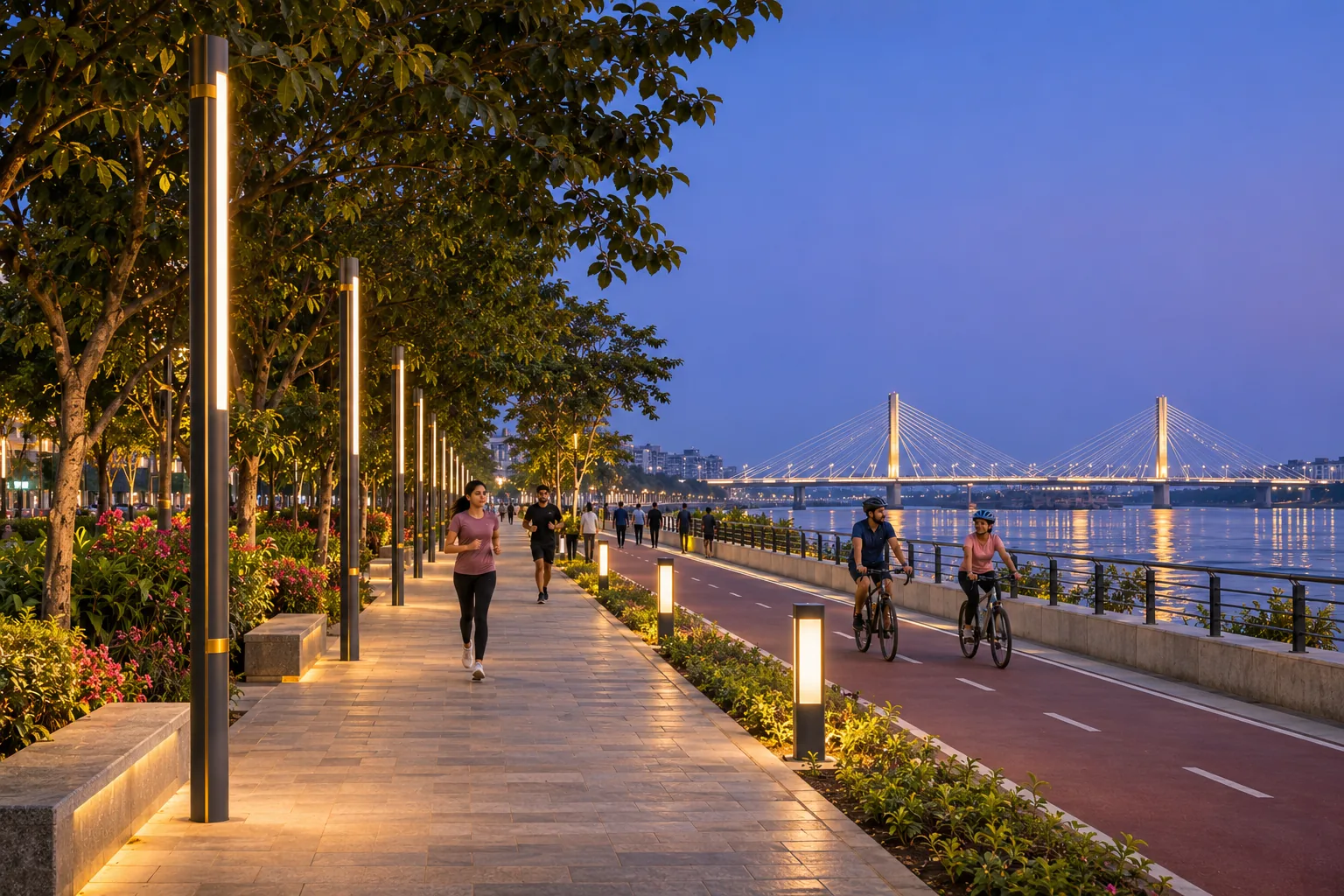
Case study
Surat, Gujarat
Profile poles with integrated light lines and column lights along a new riverfront boulevard and cycle track.
Read the case studyAsk us anything else when you request a quote.
There is no single standard. Commonly used starting points are 4 to 6 m for society and internal roads, 6 to 8 m for avenues and campus roads, and 9 to 12 m for main roads. Pedestrian streets and plazas often use lower post tops, and a lighting calculation confirms the final height.
On roads, a common starting point is three to four times the mounting height, so 4 to 6 m society poles usually start 15 to 25 m apart. Junctions, gates, speed breakers and crossings need closer spacing or an extra pole.
It depends on the road. Single arms at the kerb suit one-sided and staggered layouts on narrower roads. Twin arms suit the central median of a divided road, where one row of poles lights both carriageways.
3000 K suits residential and shopping streets, where people live and walk beside the light. 4000 K is the usual choice for main roads, where crisp, neutral light helps drivers. Keep 6000 K for industrial and security areas away from homes.
Yes. Luminex makes decorative street poles to order in your height, arm configuration and any RAL colour, in GI, MS or aluminium depending on the range. A foundation drawing and anchor bolt cage come with every pole.
Articles that go deeper into heights, spacing, materials and ratings.