Materials & finishes6 min read
Heritage and cast iron lamp posts with modern LED lighting
A period lamp post can carry modern LED without losing its character. How to choose the material, hide the light source and keep the light warm and comfortable.
By the Luminex Electronics design team, Ahmedabad
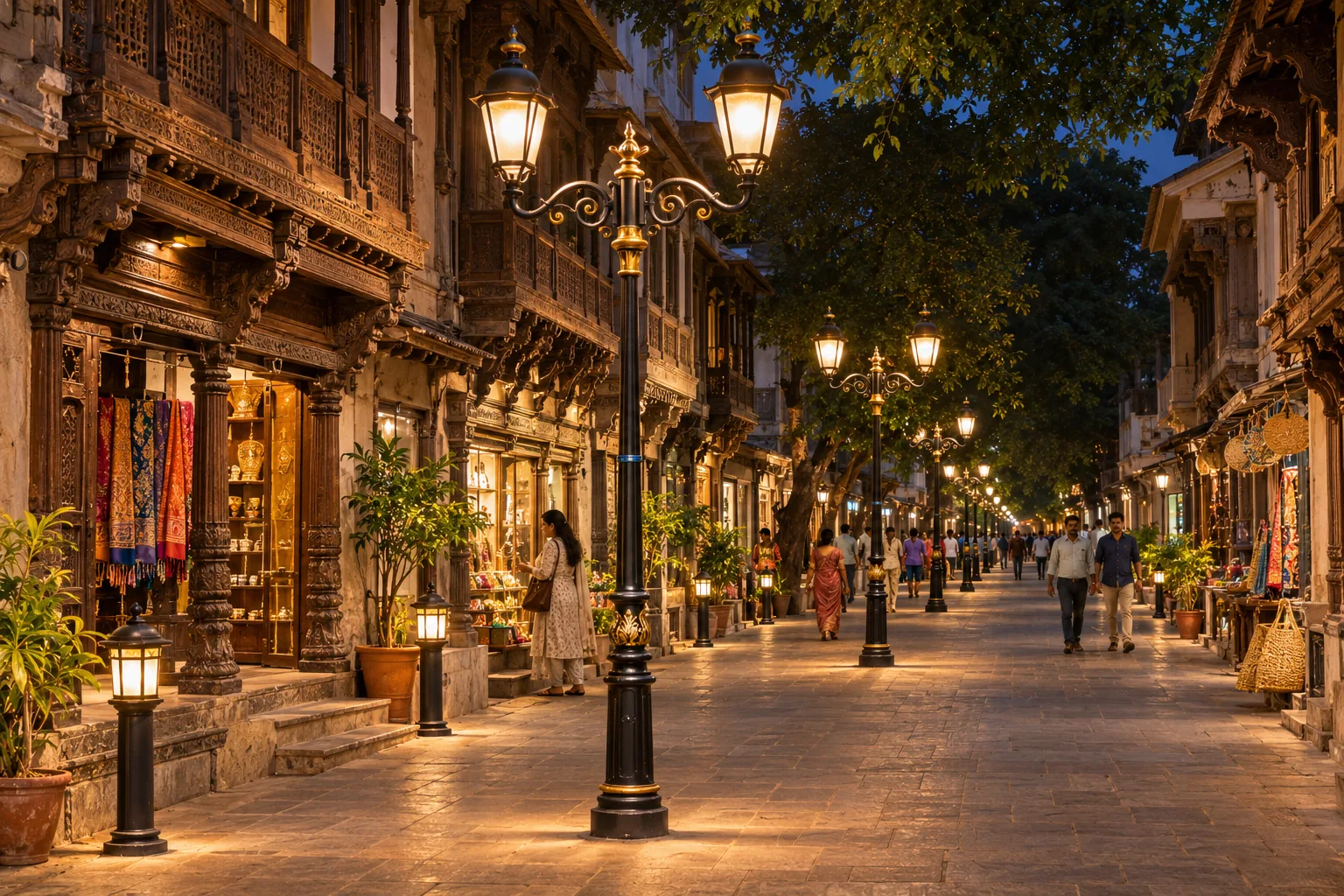
Heritage and cast iron lamp posts can carry modern LED without losing their period character, as long as the light source is hidden and shielded inside the lantern and the light stays warm. For new work, the usual approach is a strong steel or galvanised shaft dressed with cast iron or cast aluminium details, which gives the look of a traditional lamp post with less weight and less upkeep.
What makes a lamp post read as heritage
A traditional lamp post is built up from a few familiar parts, and getting their proportions right matters more than adding ornament.
- Base: a wide, decorated foot, often with a door for the wiring.
- Shaft: plain or fluted, usually tapering as it rises.
- Collar: a ring or band where the shaft changes section.
- Bracket or arms: scrolled arms that carry one, two or three lanterns.
- Lantern or globe: the head, with glazing and a roof or cap.
- Finial: the decorative point on top.
Old city markets, colonial-era civic streets, palace grounds, temple precincts and conservation areas each have their own vocabulary of these parts. Where original posts survive, photograph and measure them, and use them as the reference for any new or replacement posts. Mixing ornate Victorian-style lanterns with a modern square shaft, or a heavy base with a slender lantern, is what makes a heritage scheme look wrong.
Cast iron lamp posts, cast aluminium or steel with cast details
| Cast iron | Cast aluminium | Steel or GI shaft with cast details | |
|---|---|---|---|
| Weight | Very heavy | About a third of the weight of iron | Moderate |
| Behaviour under impact | Strong in compression, but brittle; can crack under a sharp blow | Less brittle than cast iron | Strong and resilient |
| Corrosion | Rusts slowly; needs paint upkeep | Does not rust | Shaft galvanised inside and out; cast parts painted |
| Detail | Crisp, deep detail | Good detail | Full detail where it shows: base, collar, brackets, finial |
| Best for | Restoration where the original material matters | Bollards, lighter posts and coastal sites | New heritage-style streets, plazas and campuses |
Cast iron remains the right choice when a conservation project needs to match original material. For most new projects, a steel core takes the wind load from arms and multiple lanterns, while cast collars, bases and finials carry the period look. Cast aluminium suits bollards and smaller posts, especially near the sea, because it is light and does not rust.
Putting LED inside a period lantern
The lantern is where heritage lighting most often goes wrong. A cluster of bright, bare LEDs behind clear glass looks harsh, throws glare into people's eyes and gives the game away at once.
- Hide the source: mount the LED module in the lantern roof and shine it down, or place it behind frosted, opal or textured glass, so the lantern glows rather than sparkles.
- Control the spill: traditional lanterns sent light in every direction, including up into the sky. Choose lanterns with a solid roof and downward optics, and full cut-off designs where the setting allows.
- Seal the optics: an IP65 optical compartment keeps out dust and monsoon rain, which matters more inside an ornate lantern with many joints.
- Place the driver well: house the driver where it stays cool and can be reached for service, in the lantern roof or the pole base.
- Keep sound posts in place: where existing posts are structurally sound, an LED conversion of the lanterns can be cheaper and kinder to the street than replacing everything. Check the base, the shaft and the foundation bolts for corrosion first.
Warm light at the right level
Heritage streets look best under warm white light. 2700 K is the traditional choice, and 3000 K is a close, slightly crisper alternative. A colour rendering index of 80 or more brings out the colour of sandstone, brick, carved timber and shopfronts. Our article on colour temperature for outdoor lighting explains the options.
Do not over-light. A heritage street at a moderate, even level, with facades lit gently and separately, looks far better than one flooded from tall poles. In busy markets, shopfronts add a good deal of light of their own.
Height, spacing and layout
Mounting heights of 3 to 5 m and spacings of 12 to 20 m are commonly used starting points for heritage streets and plazas, to be confirmed by calculation. Use single lanterns along lanes and footpaths, twin lanterns on wider streets, and triple-lantern columns as centrepieces on squares and at entrances.
Line posts up with the architecture: on the axis of a gateway, between arches or building bays, and in matching pairs either side of an entrance. In lanes too narrow for posts, wall-mounted lanterns on brackets keep the footway clear. Our guide to pole height and spacing covers the layout rules.
Heavier heritage posts need properly designed foundations. Ask for a foundation drawing and an anchor bolt cage, and finish the base with a decorative cover over the bolts.
Finishes and upkeep
Black, deep green and bronze are the traditional colours, often with gold or brass-effect highlights on collars, scrolls and finials. Any RAL shade can be matched to a local palette or a surviving original.
- Cast iron needs its paint kept in good order. Inspect the base each year, where water and cleaning chemicals collect, and touch up chips before rust spreads.
- Galvanised shafts under a powder coat need much less attention.
- Glazing: keep spare panes for each lantern type, because glass is the part most exposed to knocks and stones.
- Nameplates and crests: cast plates with a street name or civic crest give a street its identity, and are simplest to order together with the posts.
Frequently asked questions
Are cast iron lamp posts better than aluminium?
Each suits different work. Cast iron gives crisp, deep detail and is right where a conservation project must match original material, but it is very heavy and brittle under a sharp blow. Cast aluminium is about a third of the weight and does not rust.
Can old cast iron lamp posts be converted to LED?
Often, yes. Where existing posts are structurally sound, an LED conversion of the lanterns can be cheaper and kinder to the street than replacing everything. Check the base, the shaft and the foundation bolts for corrosion first.
What colour temperature suits heritage street lights?
Warm white suits heritage streets best. 2700 K is the traditional choice and 3000 K a close, slightly crisper alternative, with a colour rendering index of 80 or more to bring out sandstone, brick, carved timber and shopfronts.
How tall should heritage lamp posts be?
Mounting heights of 3 to 5 m, spaced 12 to 20 m apart, are commonly used starting points for heritage streets and plazas. Single lanterns suit lanes, twin lanterns suit wider streets, and triple-lantern columns make centrepieces on squares and at entrances.
Heritage lamp posts from Luminex
Choose the material for the job, keep the LED hidden and shielded inside the lantern, light in warm white and keep the finish maintained. Luminex designs and makes cast iron poles with fluted shafts, ornate bases and lantern or globe heads, on galvanised shafts with cast iron details, and aluminium heritage bollards cast in lightweight aluminium, all in Ahmedabad with cast nameplates on request. Send us photographs of the street or the posts you want to match and request a quote.