Planning & design5 min read
Riverfront and promenade lighting: a design guide
A promenade is a long line of light beside dark water. How to lay out poles and bollards, keep glare off the water, and choose fittings that survive the riverside.
By the Luminex Electronics design team, Ahmedabad
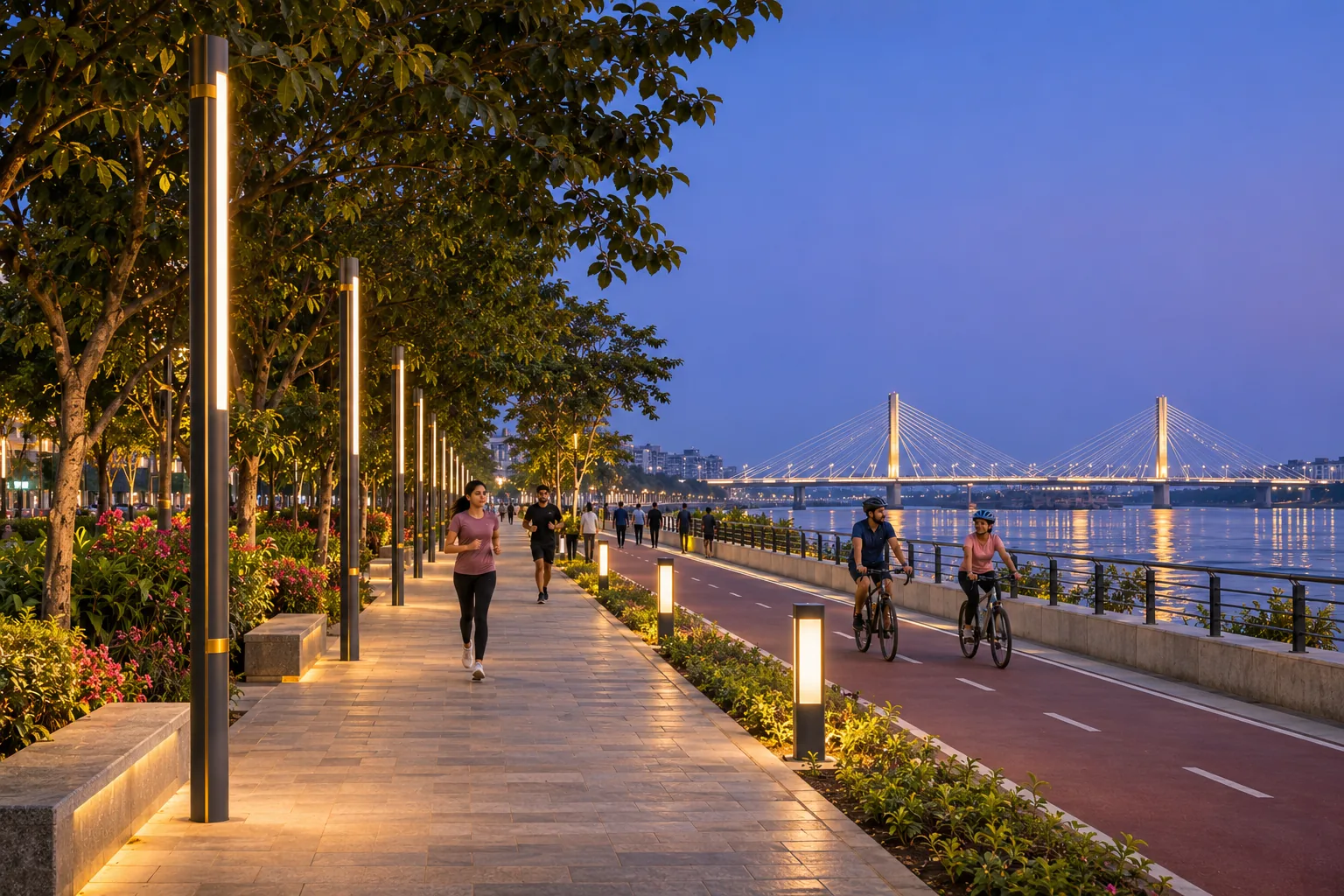
Riverfront and promenade lighting works best as a calm, continuous line of light along the water: poles or light columns set back from the edge for the main walkway, low bollards near the railings, and as little glare and spill onto the water as possible. The fittings also have to survive humidity, wind, floods and heavy public use, so materials and protection matter as much as the look.
How a promenade is used after dark
Public riverfronts, such as the Sabarmati Riverfront in Ahmedabad, have made the waterside promenade a familiar kind of public space in Indian cities, and lakefronts and seafronts follow the same pattern. After dark these are busy places: people walk, jog, cycle, sit and gather, often in large numbers on weekends and festival evenings.
Three things shape the lighting. The space is long and linear, so rhythm and consistency matter more than any single fitting. The view across the water is the main attraction, so the water itself should stay dark. And many promenades sit on more than one level, with a road above, a walkway below and steps and ramps between them, each needing its own light.
Riverfront and promenade lighting layout
| Element | Typical fittings | Placement |
|---|---|---|
| Main walkway | Light columns, profile poles or post tops | On the land side, in a steady rhythm |
| Cycle track | Low-glare poles or columns | Even light, nothing shining into riders' eyes |
| Water's edge and railings | Bollards with down-light | Set back from the railing, light aimed onto the walkway |
| Seating, decks and viewpoints | Bollards or low columns | Local, softer light so people can enjoy the view |
| Steps, ramps and level changes | Bollards and side lighting | Every flight, top and bottom |
| Upper road | Arm-mounted street poles | Road optics, coordinated with the walkway rhythm |
Keep one pole family and one colour temperature along the whole length, and repeat the spacing so the line of light reads clearly from across the water. Mark entrances, junctions and viewpoints with a change, such as a taller column or a twin head, rather than a different design.
Glare, reflections and the view
Water doubles every light source. A bright fitting near the edge is seen twice, once directly and once reflected, so glare that is tolerable on a street becomes uncomfortable at the waterside.
- Aim light down and away from the water: use shielded optics and full cut-off heads, and avoid fittings that face across the river.
- Keep light columns soft: columns that glow along their height should be bright enough to read as a line, not so bright that they dazzle.
- No up-light: it washes out the sky and the view of bridges and the far bank.
- Warm colour: 3000 K suits most promenades. Near wetlands, nesting birds or sensitive river habitats, amber of around 2200 K is gentler still.
- Keep the water dark: a dark river makes the lights of the far bank, bridges and skyline visible, which is why people come.
Railings and the water's edge
The edge is where safety and comfort meet. People lean on railings to look at the water, so bollards should stand back from the railing, leaving a clear strip to stand in, and send their light onto the walkway rather than outwards. Where a cycle track runs beside the railing, keep bollards on the walkway side so cyclists are not riding between a fitting and the drop.
Avoid placing fittings, ledges or brackets in a position where children could use them to climb the railing. Low fittings in busy public areas should be IK10 rated and built without sharp edges or loose parts.
Corrosion, wind and floods
- Humid, splashed air: riverside and seafront air keeps surfaces wet for long periods. Specify galvanised steel under a powder coat, or aluminium, with stainless steel fixings. Our guide to galvanising and powder coating explains why.
- Wind: open water gives wind a long, unobstructed run, so poles and foundations must be designed for the site's basic wind speed under IS 875 (Part 3).
- Floods: lower promenades may flood in the monsoon. Keep feeder pillars, junction boxes and cable joints above the highest flood level, and use IP67 or IP68 fittings anywhere that may be submerged.
- Ingress protection: IP66 suits exposed poles and bollards that face driving rain and washing down.
- Silt and debris: after a flood, check and clean low fittings before switching them back on.
Maintenance along a long site
A promenade can run for kilometres with hundreds of identical fittings, so maintenance needs planning from the start.
- Divide the length into sections on separate circuits, so a fault darkens only a short stretch.
- Keep spare LED modules, drivers, glazing and complete bollards of each model.
- Make sure maintenance vehicles can reach the walkway, or choose fittings that can be serviced from the ground.
- Dim late at night when the promenade empties, and consider motion sensors on quieter stretches.
Frequently asked questions
How do you reduce glare on a riverfront promenade?
Aim light down and away from the water with shielded, full cut-off optics, avoid fittings that face across the river, and keep glowing light columns soft. Water reflects every bright source, so glare that is tolerable on a street becomes uncomfortable at the waterside.
What colour temperature suits a riverfront?
3000 K suits most riverfronts and promenades, giving warm, comfortable light for walking and sitting. Near wetlands, nesting birds or sensitive river habitats, amber of around 2200 K is gentler still on wildlife.
Where should bollards go along a promenade railing?
Set bollards back from the railing so people have a clear strip to stand and lean in, and aim their light onto the walkway rather than outwards. Where a cycle track runs beside the railing, keep bollards on the walkway side.
How do you protect promenade lights from floods?
Keep feeder pillars, junction boxes and cable joints above the highest flood level, use IP67 or IP68 fittings anywhere that may be submerged, and check and clean low fittings after a flood before switching them back on.
Riverfront lighting with Luminex
Keep a steady line of light on the land side, keep the water dark, protect the edge, and choose materials and ratings for the riverside. Luminex designs and makes profile poles with integrated light lines, column lights that glow along their height and square bollards in Ahmedabad, in any RAL colour. See our riverfronts and promenades page, then request a quote.