Planning & design6 min read
Double arm decorative pole vs single and multi-arm poles
Single, double or multi-arm? How the arm layout of a decorative pole decides where its light lands, how it looks and how strong the pole has to be.
By the Luminex Electronics design team, Ahmedabad
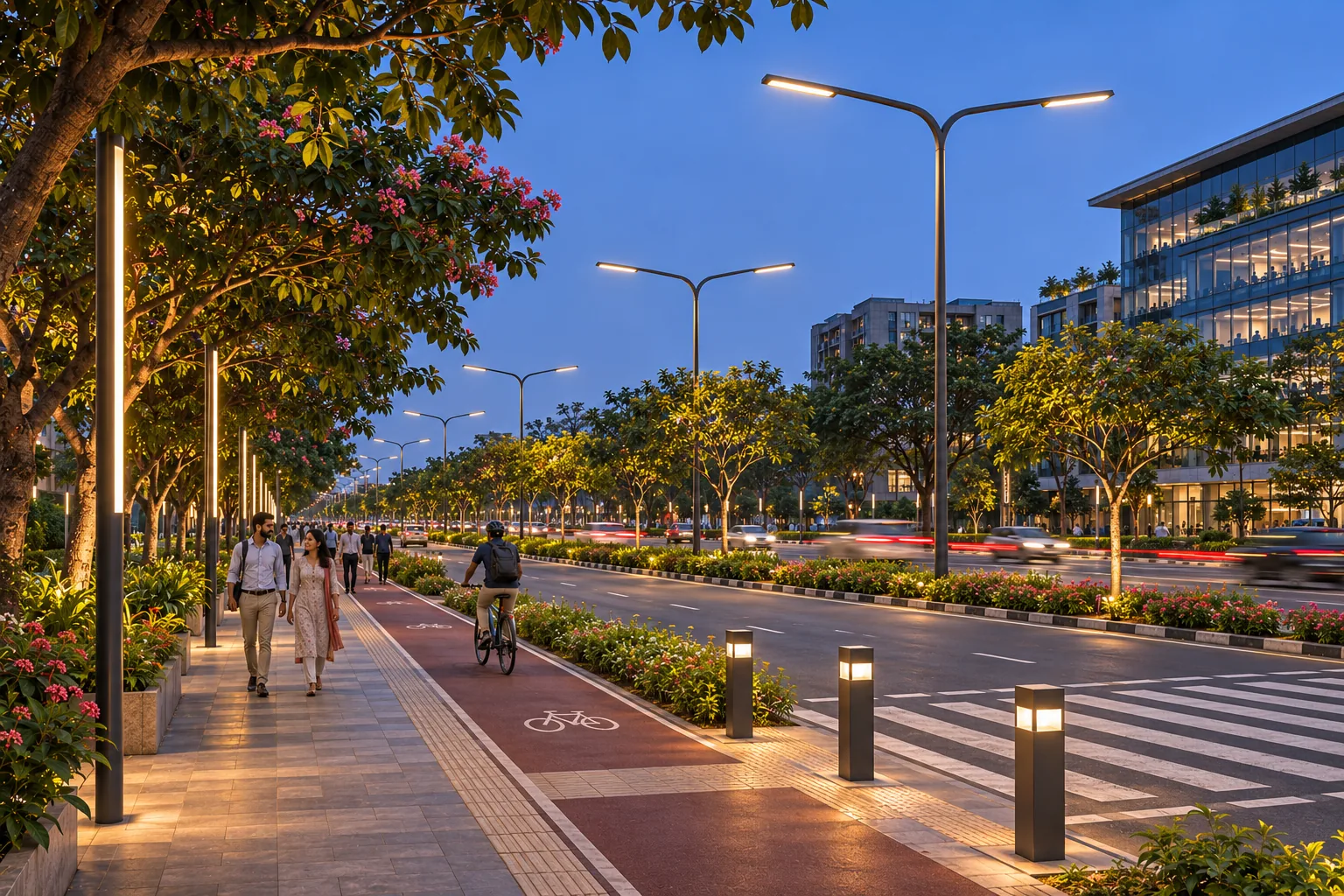
A double arm decorative pole carries two luminaires from one shaft, which makes it the usual choice for road medians, wide avenues and entrances where light is needed on both sides. Single arm poles suit roads and paths lit from one edge, while multi-arm poles with three or more heads belong in plazas, junctions and squares where light is needed all round.
What the arm actually does
The arm decides where the luminaire sits in relation to the pole: how far out it reaches, how high it sits and which way it faces. That, in turn, decides where the light lands. An arm carries the light over the road instead of the verge, or holds two lanterns apart so a column lights a whole court.
The arm also sets the character of the pole. Straight and angled arms read as modern; curved, swan-neck and Y-shaped arms are softer; scrolled brackets with lanterns read as heritage. Because the arm is so visible, it is worth choosing the layout first and the decoration second. Outreach and overhang limits are covered in our guide to street light pole height and spacing, so this article concentrates on how many arms to use and where.
Single arm poles: one direction of light
A single arm pole throws its light one way. It is the natural choice wherever the light comes from one edge:
- Society and campus roads lit from one side, or in a staggered layout from both sides.
- Footpaths and cycle tracks that run beside a boundary wall or building.
- The edge of a car park, with the arm facing into the parking bays.
- Heritage lanes, where a single lantern on a scrolled bracket keeps the scale small.
Set the pole at the back of the footpath with the arm reaching over the area to be lit. A single arm puts its weight and wind load to one side of the shaft, so the pole, base plate and foundation are designed for that uneven load.
Double arm decorative poles: medians, avenues and entrances
A double arm decorative pole puts two luminaires on one shaft, usually facing in opposite directions. It earns its place in a few common situations.
- Central medians: on a divided road, a twin-arm pole in the median lights both carriageways, which saves a row of poles and keeps the verges clear.
- Road and footpath together: some designs carry a higher arm over the road and a lower one over the footpath, so each gets light at a suitable height.
- Between two paths or two rows of parking: one pole serves both sides.
- Avenues and entrances: twin heads give a symmetrical look that suits formal approaches, gateways and campus avenues.
Double arms come as straight T-arms, Y-arms, curved twin arms and scrolled twin lanterns, so the same layout can be modern or heritage. Twin arms balance each other's weight, but wind still acts on both heads, so the shaft is sized for the full head area.
Multi-arm poles: three, four and cluster heads
Poles with three or more heads light all round, and they work as centrepieces. Typical places are plazas, squares, junctions, roundabouts, temple forecourts and campus quadrangles.
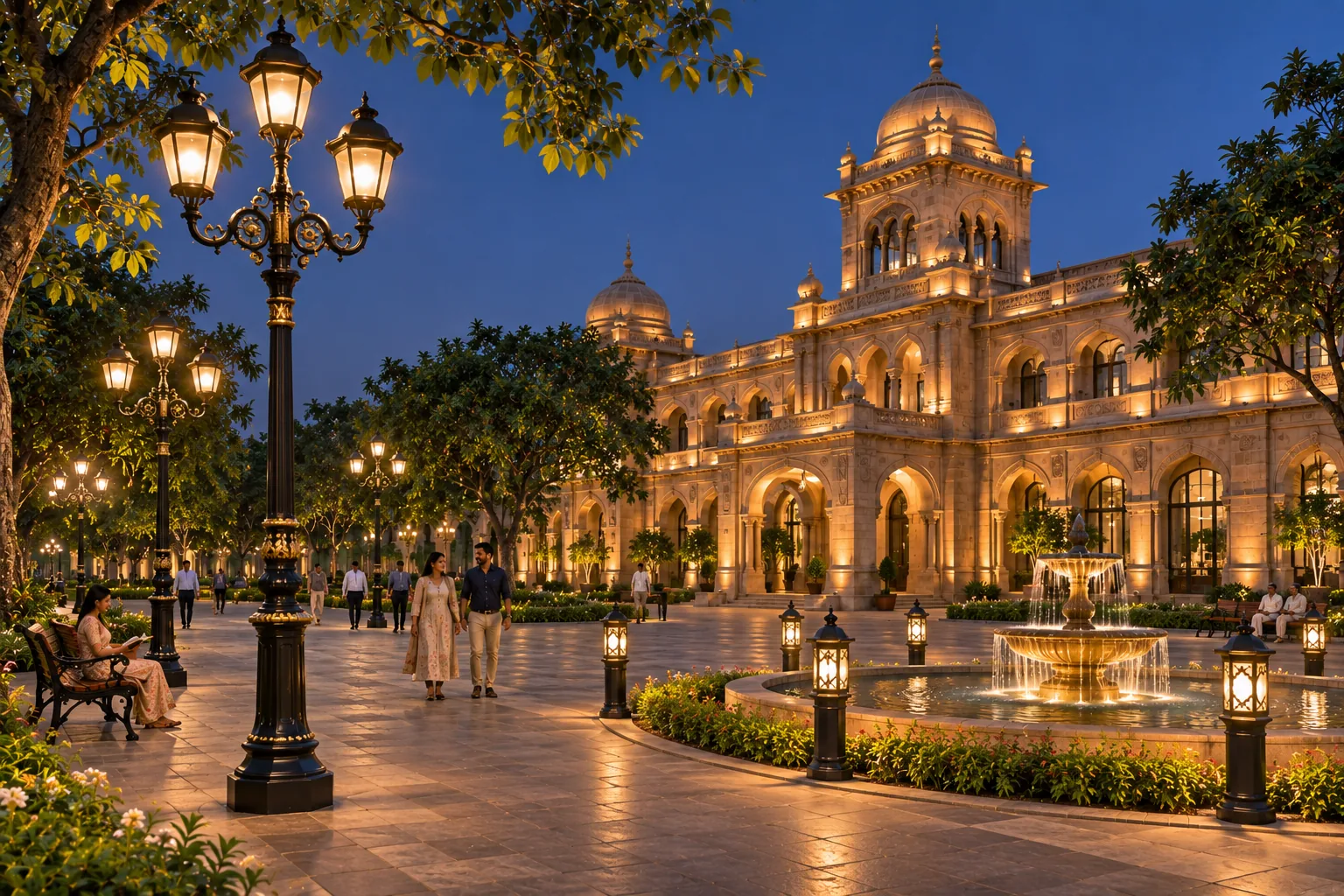
Triple-lantern columns with scrolled brackets are a classic heritage form. Modern versions use clusters of three or four heads, or a ring of luminaires around the top of the shaft. For car parks and sports areas, a crossarm carrying several floodlights does the same job at a larger scale.
Mount multi-arm heads high enough that several bright sources at once do not glare at people nearby. And remember that one tall cluster pole lights a space from a single point: a large plaza is often lit more evenly by several smaller poles, with a cluster column as the focal point.
Arm layouts compared
| Arm layout | Light pattern | Best for | Watch out for |
|---|---|---|---|
| Single arm | One direction | Roads lit from one edge, paths, car park edges | Uneven load on the shaft |
| Double arm, opposite | Both sides of the pole | Medians, avenues, between two paths | Both heads need maintenance access over traffic |
| Double arm, at an angle | Two directions at once | Corners, junctions, bends | Light can spill where it is not needed |
| Triple or four heads | All round | Plazas, squares, junctions, forecourts | Glare at low mounting heights |
| Crossarm with floodlights | Wide area | Car parks, yards, sports grounds | Aiming and glare control |
| Post top, no arm | All round, from the top | Gardens, paths, courtyards | Less reach over roads |
To choose, start from where the light is needed: one side, both sides or all round. Then check the road width against the mounting height, choose an arm style that matches the setting, and confirm the layout with a lighting calculation.
Structure, wind and maintenance
Every extra head adds weight and wind area, and every arm adds leverage on the shaft. The shaft, its wall thickness, the base plate and the foundation all have to suit the full head configuration and the basic wind speed of the site under IS 875 (Part 3). Our article on decorative pole foundations and anchor bolts explains how this reaches the ground.
- Orientation: decide which way each arm must face before the foundation is cast, because the anchor bolt pattern fixes the pole's orientation.
- Arm joints: bolted spigot joints let an arm be replaced or turned later; welded arms give a cleaner line but are fixed for life.
- Wiring: run a separate cable to each head through the arm, so heads can be switched or dimmed independently.
- Access: heads over a road or median need a hydraulic platform and traffic management, so choose drivers and optics that need little attention.
Frequently asked questions
Where should a double arm decorative pole be used?
Use a double arm pole where light is needed on both sides: in the central median of a divided road, between two paths or rows of parking, and on formal avenues and entrances where a symmetrical look suits the setting.
What is the difference between a single arm and a double arm pole?
A single arm pole carries one luminaire and throws light one way, which suits roads and paths lit from one edge. A double arm pole carries two luminaires, usually facing opposite ways, so one shaft lights both sides.
Does a double arm pole need a stronger foundation?
The shaft, base plate and foundation must suit the full head configuration. Twin arms balance each other's weight, but wind acts on both heads, so the pole is sized for the total head area and the site's basic wind speed under IS 875 (Part 3).
When should I use a multi-arm or triple lantern pole?
Use three or more heads where light is needed all round and the pole is a centrepiece: plazas, squares, junctions, roundabouts, temple forecourts and campus quadrangles. Mount the heads high enough to avoid glare from several bright sources at once.
Arm configurations from Luminex
Choose the arm layout from where the light must land, match the arm style to the setting, and design the pole and foundation for the full head load. Luminex designs and makes poles with single, twin and cluster heads in Ahmedabad, from round poles and square poles to triple-lantern cast iron columns, each made to your height and arm configuration. See our single and double arm poles, then send us your layout and request a quote.