Buying guides6 min read
Bollard lights: types, heights and spacing explained
Bollards light paths, edges and entrances at ground level. The main types, the right height for each place and how far apart to set them.
By the Luminex Electronics design team, Ahmedabad
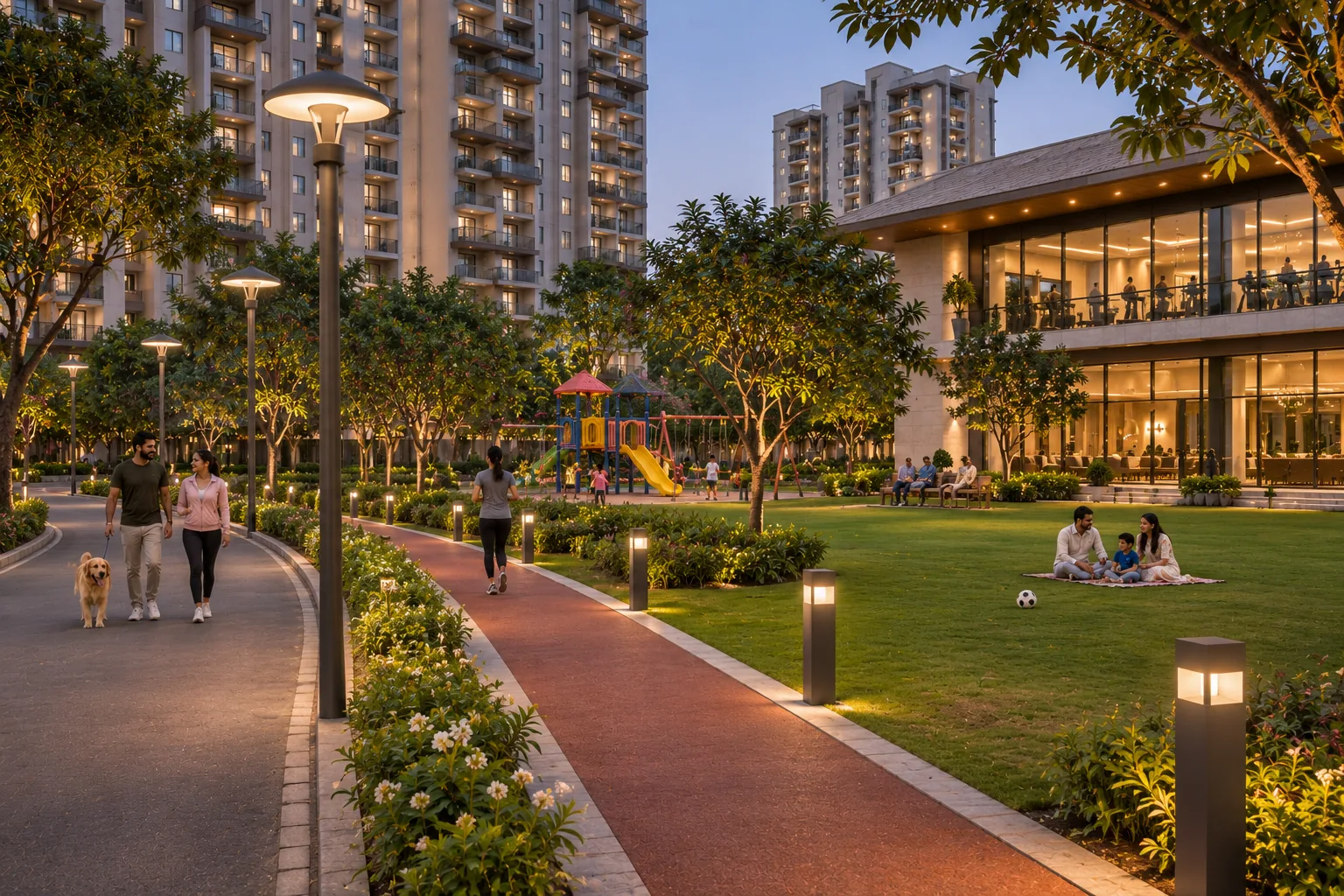
Bollard lights are short, post-shaped lights, usually between 450 mm and 1.2 m tall, that light paths, edges and entrances from low level. For most garden and society walkways, bollards of 600 mm to 1 m set 4 to 8 m apart give a clear, comfortable path. The right type, height and spacing depend on the width of the path, the light output of the bollard and what the light needs to show.
What bollard lights do well, and what they don't
Bollards are the natural choice for wayfinding. They mark the edge of a path, a step, a junction or a planting bed, and because the light source sits below eye level they give very little glare. They also keep light close to the ground, where it is needed, which helps keep the sky and neighbouring windows dark.
They have limits. Light from below eye level does not light faces well, so at gates, building entrances and car parks, where people need to recognise each other, combine bollards with poles or wall lights. A lighting bollard is also not a traffic barrier. If vehicles must be stopped, use a structural bollard designed for that job.
Types of bollard lights
| Type | How it spreads light | Typical use |
|---|---|---|
| Round bollards | All round (360°), or in one direction through a window or under a cap | Societies, parks, driveways, campuses |
| Square bollards | Through slots or panels, often on one or two faces | Modern landscapes, entrances, plazas |
| Pathway bollards | Downward, through louvres or a shielded head, with low glare | Walkways, park paths, township footpaths |
| Architectural bollards | Frames, lanterns and sculpted bodies, with zero up-light options | Plazas, office campuses, hotels |
| Laser-cut bollards | Patterned light through a cut shell | Resorts, gardens, retail |
| Heritage bollards | Lantern or globe heads on fluted bodies | Heritage streets, hotel grounds, temples |
| Wood-effect bollards | Shielded down-light from a timber-look body | Resorts, villas, planting beds |
A useful split is between bollards that light the ground and bollards that are meant to be seen. Down-light designs put most of their output on the path. Lanterns, glowing bodies and laser-cut shells are partly decorative, so they mark a route well but light less of the ground for the same wattage.
Choosing the right height
| Height | Where it fits | Notes |
|---|---|---|
| 450 – 600 mm | Planting edges, narrow garden paths, beside steps | Very low glare, short reach |
| 600 – 900 mm | Most walkways, society paths and park routes | A good balance of reach and comfort |
| 900 – 1200 mm | Plazas, entrances, driveways and wider paths | Longer reach and more visible by day |
A taller bollard throws light further along the path, but its light source moves closer to the eye level of children and seated people, so shielding matters more. On driveways, a taller bollard is easier for drivers to see and less likely to be hit while reversing.
How far apart to space bollards
A spacing of 4 to 8 m is a commonly used starting point. Where a bollard sits in that range depends on several things:
- Light output and optic: a wide, even down-light can be spaced further apart than a narrow or decorative one.
- Continuous or marker lighting: for an evenly lit path, the pools of light should meet or nearly meet. For marker lighting along a garden edge, wider gaps are fine.
- Path surface: light paving reflects more than dark asphalt or grass.
- How busy the path is: for reference, the pedestrian classes of the European standard EN 13201-2 range from 2 lux average on the quietest routes to 15 lux on the busiest. Quiet garden paths sit at the low end.
As a rule of thumb, paths up to about 2 to 3 m wide can be lit from one side. Wider paths and plazas are lit from both sides, staggered, or with a mix of bollards and low poles. Before filling in the regular spacing, put a bollard at each junction, change of direction, step and ramp, because those are the places people need to see most.
Set bollards back a little from the path edge so that mowers, wheelchairs, bicycles and car doors clear them. About 300 to 500 mm is a common starting point, adjusted for the planting and kerb detail.
Glare, light pollution and colour temperature
Look at a bollard from where people will actually see it: walking towards it, sitting on a nearby bench, or from a window above. The light should land on the path, not in people's eyes. Louvres, deep shields and recessed light sources all help.
Avoid bollards that throw light upwards into trees and the sky unless that is the intended effect. Warm white of around 3000 K suits gardens, societies and resorts, while 4000 K suits more functional areas such as service roads. Luminex bollards use LED from 12 to 24 W and are offered in 3000 K, 4000 K and 6000 K. Our lighting guide explains distribution types and dark-sky principles in more detail.
Mounting, protection and maintenance
- Mounting: most bollards are fixed with anchor bolts through a base plate into a concrete footing. Pathway bollards can also be spiked into soft landscape, and some designs are embedded directly in concrete.
- Cabling: plan the cable route and a loop-in, loop-out connection at each bollard before paving and planting.
- Ingress protection: IP65 is the sensible minimum outdoors, because sprinklers, rain and hosing all reach bollards.
- Impact: IK08 suits most private grounds. In public parks, schools and busy plazas, IK10 diffusers are worth specifying. Our guide to IP and IK ratings explains both.
- Materials: aluminium bodies do not rust, which suits irrigated landscapes. Laser-cut designs in GI or MS need a good galvanised or painted finish.
- Maintenance: easy access to the lamp, clean lenses and spare modules of the same model keep a long path looking even.
Frequently asked questions
What is the standard height of a bollard light?
Bollard lights are usually between 450 mm and 1.2 m tall. Heights of 600 to 900 mm suit most walkways and society paths, 450 to 600 mm suits planting edges and steps, and 900 to 1200 mm suits plazas, entrances and driveways.
How far apart should bollard lights be placed?
A spacing of 4 to 8 m is a commonly used starting point. Wide, even down-light bollards can sit further apart than decorative ones, and a bollard should go at every junction, step and change of direction before the straight runs are filled in.
What IP rating do outdoor bollard lights need?
IP65 is the sensible minimum outdoors, because rain, sprinklers and hosing all reach bollards. For impact, IK08 suits most private grounds, while IK10 diffusers are worth specifying in public parks, schools and busy plazas.
Are bollard lights enough to light a gate or car park?
Usually not on their own. Light from below eye level does not light faces well, so at gates, entrances and car parks, where people need to recognise each other, combine bollards with poles or wall lights.
Choosing bollards with Luminex
Pick the type for the job, keep the height in the 600 mm to 1 m range for most paths, start at 4 to 8 m spacing and check the result before installation. Luminex designs and makes pathway bollards, round bollards and square bollards in Ahmedabad, in finishes to match our poles and in any RAL colour. Send us your landscape plan and request a quote.