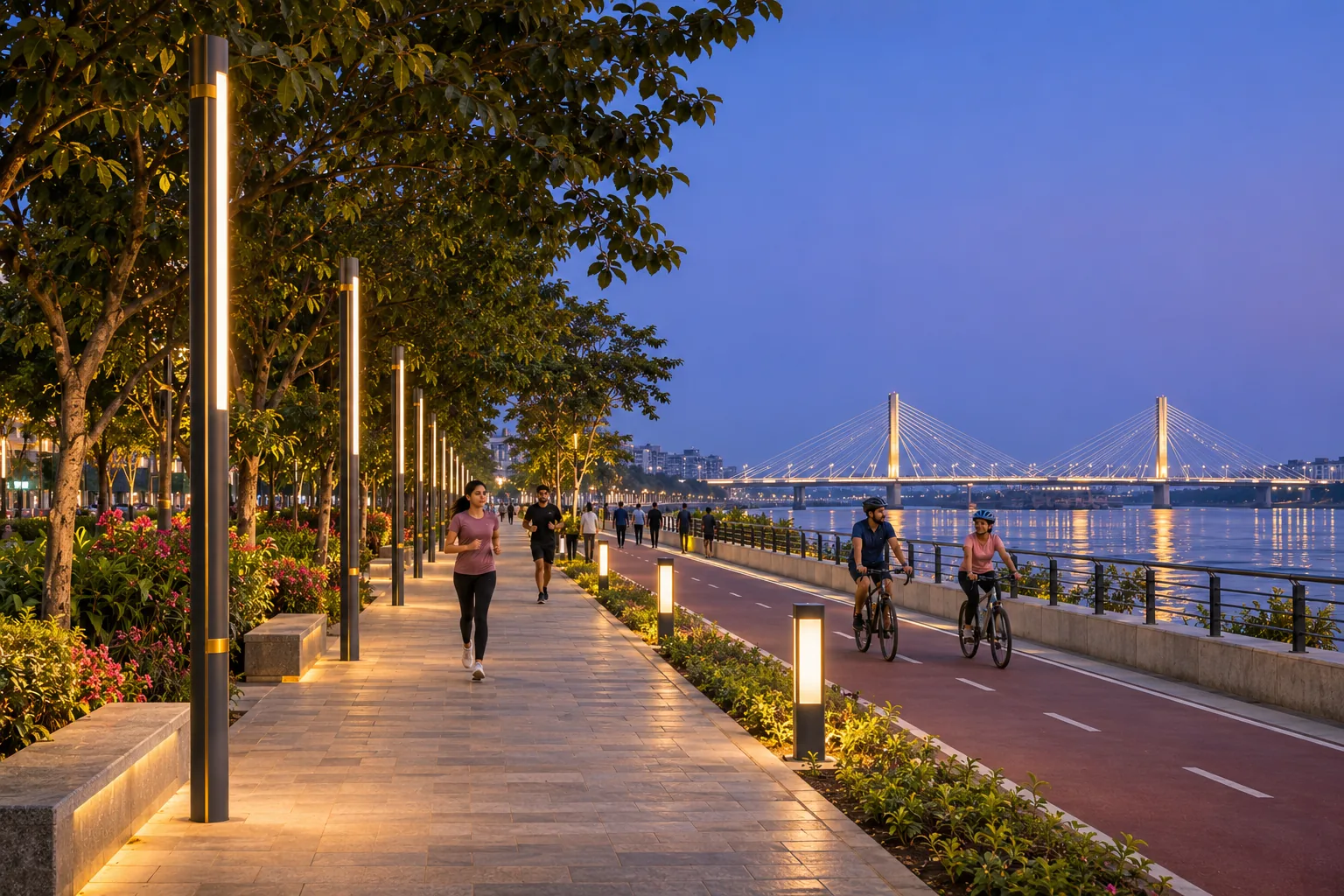
Planning & design6 min read
Garden and landscape lighting with poles and bollards
Good garden lighting works in layers and keeps its fittings low, warm and shielded. How to plan paths, lawns and features with bollards and garden poles.
By the Luminex Electronics design team, Ahmedabad
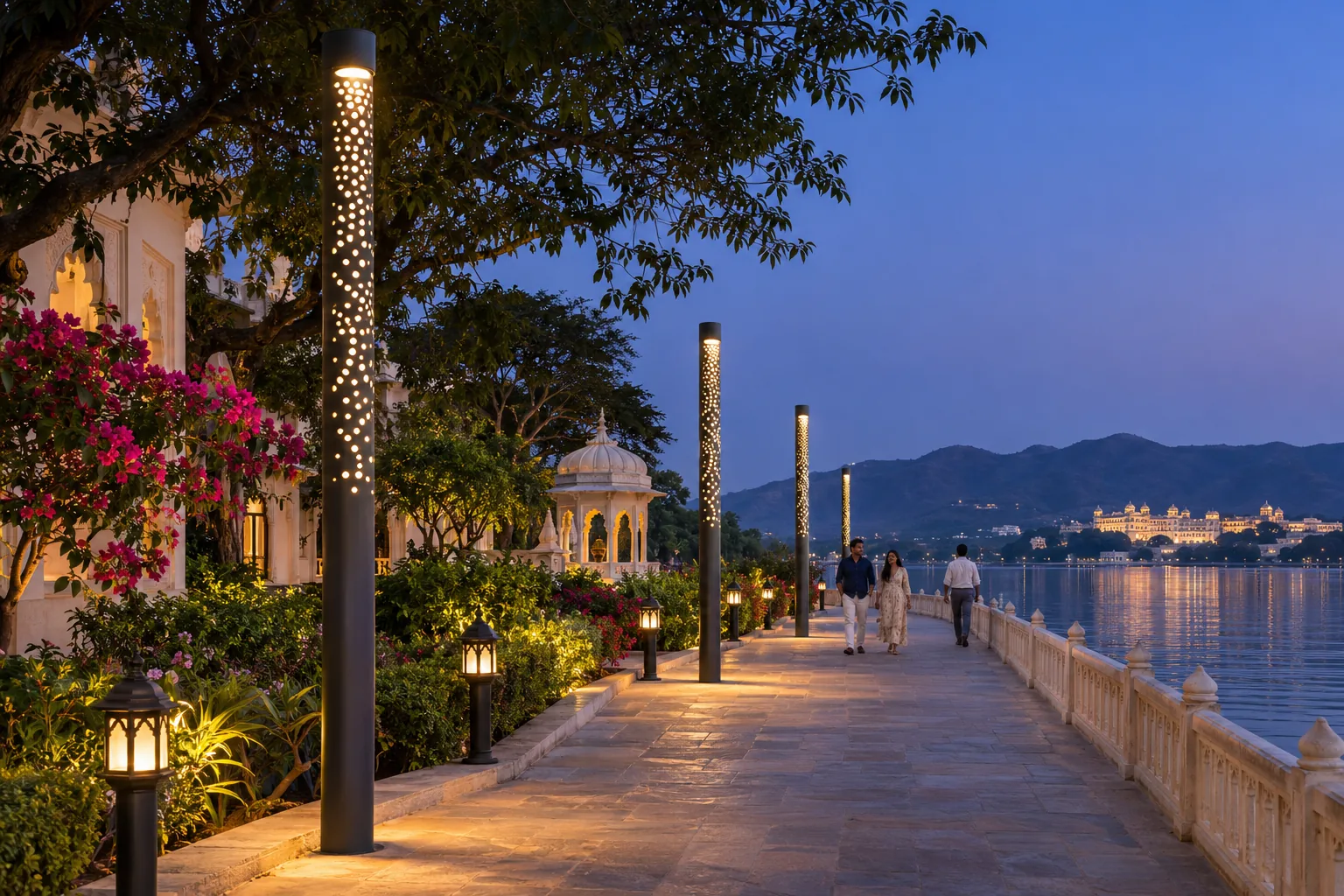
Garden and landscape lighting works best in layers: bollards to guide people along paths, garden poles to give soft light over lawns and seating, and a few features to give the space a focal point. Keep fittings low and shielded, use warm white of 2700 K to 3000 K, and plan the cables before the planting so the scheme can grow with the garden.
Think of garden and landscape lighting in layers
Most well-lit gardens, resort grounds and landscaped campuses use three or four layers of light, each with its own job.
| Layer | Fittings | Typical height | What it does |
|---|---|---|---|
| Guidance | Pathway, wooden or laser-cut bollards | 0.6 – 1.0 m | Marks paths, steps, edges and junctions |
| Ambient | Garden post tops and lanterns | 2.5 – 3.5 m | Soft, even light over lawns, courts and seating |
| Feature | Laser-cut poles and light columns | Set by the design | Gives the garden a focal point and a character |
| Accent | Small spotlights on trees, sculpture and water | Ground level | Adds depth and draws the eye |
Start with guidance, add ambient light where people gather, and finish with a few features. Not everything needs light. Dark areas between lit ones give a garden depth, and they keep the sky and neighbouring homes dark too.
Paths and steps: start with bollards
Bollards are the backbone of garden lighting. Place one first at every junction, step, ramp and change of direction, then fill the straight runs at a spacing of 4 to 8 m. Narrow paths are usually lit from one side; wide promenades from both sides, staggered.
Choose down-light bollards with louvres or a shielded head, so the light lands on the path rather than in people's eyes. Heights of 600 to 900 mm suit most garden paths, and 450 to 600 mm suits planting edges and the sides of steps. On steps, light each flight from the side so the edges of the treads are clear. Our guide to bollard lights covers types and spacing in more detail.
Lawns, courts and seating: garden post tops
Where people sit, play or gather, garden post tops of 2.5 to 3.5 m give gentle light over a wider area. A spacing of 10 to 15 m is a commonly used starting point. Post tops and lanterns that spread light all round the pole suit lawns, courtyards and play areas.
Put poles at the edges of lawns rather than in the middle, so the open space stays usable and the light falls across it. Light seating, gazebos and play equipment directly, because those are the places people use after dark. Lanterns with frosted or opal glazing look softer than clear glass with a visible LED.
Features: patterned light and glowing columns
Laser-cut poles and bollards throw patterns of light and shadow onto the ground around them. They work best where the pattern lands on smooth paving or close-cut lawn; in dense shrubs the pattern is lost. Check the scale of the pattern at the real mounting height, and keep the light source shielded from view.
Light columns and profile poles glow along their height, so they mark entrances, drives and the end of a vista. Keep features to a few focal points. A whole garden of feature poles stops being special.
Choosing fittings that sit in the planting
- Wood-effect bollards give a timber look on aluminium bodies, without the rot and splitting of real wood.
- Dark finishes such as graphite black, anthracite grey, bronze and corten effect recede into planting by day, so the light, not the fitting, is what people notice.
- Scale: choose bollard heights with mature planting in mind. A 600 mm bollard can disappear behind a shrub within a few seasons.
- Materials: aluminium and galvanised steel suit irrigated beds, where sprinkler water keeps the base wet for much of the year.
- One family: keep bollards, post tops and feature poles in a related style and finish, so the garden reads as one design.
Light that respects the landscape
Warm white of 2700 to 3000 K flatters leaves, flowers, stone and skin, and attracts fewer insects than blue-rich light. Near wetlands, lakes and nature reserves, amber of around 2200 K is gentler still on wildlife. Our article on colour temperature for outdoor lighting compares the options.
- Use shielded fittings that send no light above the horizontal, so the night sky stays dark.
- Keep uplighting of trees restrained, and aim it into the canopy rather than past it into the sky.
- Watch for reflections in water. A bright fitting beside a pond appears twice.
- Use timers to switch feature lighting off late at night and to dim paths when the garden empties.
- Check views from neighbouring windows and from across the garden for glare.
Practical installation points
- Draw cable routes before planting, with ducts under paths and around future tree positions.
- Keep trenches outside the root zones of existing trees, or dig by hand near roots.
- Specify IP65 as a minimum, and set sprinkler heads so they do not spray straight at fittings.
- Set bollard bases slightly above finished soil or mulch level, with free-draining material underneath.
- Spike-mounted pathway bollards can be moved as planting grows; use concrete footings in public and high-traffic areas.
- Leave a little slack cable at each fitting so it can be moved or replaced without new joints.
- Make sure each fitting can be reached for cleaning and maintenance once planting has matured.
Frequently asked questions
How far apart should garden lights be?
Pathway bollards commonly start at 4 to 8 m apart, and garden post tops of 2.5 to 3.5 m at 10 to 15 m. Place a bollard at every junction, step, ramp and change of direction first, then fill in the straight runs.
What is the best height for garden bollard lights?
Heights of 600 to 900 mm suit most garden paths, while 450 to 600 mm suits planting edges and the sides of steps. Choose with mature planting in mind, because a low bollard can disappear behind a growing shrub within a few seasons.
What colour light is best for a garden?
Warm white of 2700 to 3000 K flatters leaves, flowers, stone and skin, and attracts fewer insects than blue-rich light. Near wetlands, lakes and nature reserves, amber of around 2200 K is gentler still on wildlife.
What IP rating do garden lights need?
Specify IP65 as a minimum, because rain and sprinklers reach every garden fitting. Set sprinkler heads so they do not spray straight at the lights, and keep bollard bases slightly above soil or mulch level with free-draining material underneath.
Lighting gardens with Luminex
Layer the light, keep it low, warm and shielded, and plan the cabling with the planting. Luminex designs and makes garden poles with lantern, leaf and branch designs, wooden bollards in teak, oak and ash looks, and laser-cut bollards in standard motifs or your own artwork, all in Ahmedabad. Send us your landscape plan and request a quote.